Handmade Museum Quality Oil Painting Reproductions & Custom Portrait
Handmade Museum Quality Oil Painting Reproductions & Custom Portrait

"Bonaparte Crossing the Alps" is one of the most iconic and dramatic representations of Napoleon Bonaparte, the renowned French military leader, captured in 1848. The painting, created by the artist Jacques-Louis David, conveys not only the momentous historical significance of Napoleon's famous crossing but also showcases the depth of emotion and grandeur associated with the era. As one of David's most celebrated works, it captures the power and ambition of Napoleon while also highlighting the artist's exceptional skill in blending historical narrative with artistic mastery.
Artist: Jacques-Louis David
Jacques-Louis David (1748–1825) was a pivotal figure in French neoclassical art. As one of the most influential painters of his time, David's work was deeply rooted in the political and social movements of revolutionary France. His oil paintings are known for their dramatic compositions, crisp lines, and ability to convey strong emotional messages. David served as the court painter for Napoleon Bonaparte, and many of his works reflect the grandeur and power of the Napoleonic era.
David was a key figure in the neoclassical movement, which emphasized the use of classical themes and ideals to express the values of the time. His works, including "The Death of Socrates," "The Oath of the Horatii," and "Napoleon Crossing the Alps," are considered masterpieces that exemplify the neoclassical style's commitment to portraying historical and mythological themes in a grand and heroic light.
The Painting: Bonaparte Crossing the Alps
Created in 1848, "Bonaparte Crossing the Alps" depicts Napoleon Bonaparte on horseback, riding across the rugged terrain of the Alps as he makes his way into Italy during the campaign of 1800. This famous crossing occurred as part of the Second Italian Campaign during the Napoleonic Wars, which ultimately led to his victory at the Battle of Marengo.
David’s depiction of this moment is one of striking symbolism. Napoleon is portrayed in a dynamic, heroic pose—sitting astride his horse, his gaze determined and unwavering, with the rugged mountains and stormy skies surrounding him. His calm demeanor and commanding posture contrast against the turbulent backdrop, signifying his leadership and strength even in the face of nature’s challenges.
The composition is a carefully calculated balance of strength and serenity. Napoleon’s figure is powerful and commanding, yet there is a sense of human fragility in the way the horse stands on the precarious mountain ledge. The billowing cape and the natural landscape behind him suggest movement and momentum, symbolizing Napoleon’s forward-looking vision and his ability to overcome adversity.
This painting is not just a historical moment captured on canvas; it is a portrayal of the mythic qualities of Napoleon. David’s artistic technique brings a sense of grandeur to the scene, transforming a military action into an almost mythical, heroic event. The painting is an example of how David used his artistic abilities to glorify Napoleon, presenting him as a leader who could conquer not just nations, but also nature itself.
Historical Context and Significance
Napoleon’s crossing of the Alps was a pivotal moment in his military career. In 1800, Napoleon led the French army over the treacherous mountain range to outmaneuver the Austrian forces and strike a decisive blow in Italy. The campaign demonstrated Napoleon’s strategic genius and his ability to command both his troops and the elements.
The painting was created several decades after the actual event, during a time when Napoleon had already fallen from power. David, who had been a loyal supporter of Napoleon, painted "Bonaparte Crossing the Alps" as a means to preserve Napoleon’s legacy. The image of Napoleon as a heroic figure riding across the Alps became an enduring symbol of his greatness and military prowess.
The painting was commissioned by the King of France, Louis-Philippe, who, during the 1840s, sought to distance himself from the more controversial aspects of the Napoleonic era. Despite this, the painting was used to depict Napoleon as a powerful and almost divine figure, emphasizing the grandeur of his reign. David's work reinforced the image of Napoleon as a leader who transcended the ordinary and was capable of achieving the extraordinary.
David’s Influence on the Napoleonic Iconography
Jacques-Louis David played a central role in shaping the visual representation of Napoleon, and "Bonaparte Crossing the Alps" is one of the key pieces that contributed to the construction of Napoleon's image as a larger-than-life figure. Through his art, David transformed Napoleon from a mere military leader into an almost mythological hero.
In addition to this painting, David also created other works depicting Napoleon, such as "Napoleon in his Study" and "Napoleon Crossing the Alps" (the version of the painting shown to the public). Each of these works cemented the idea of Napoleon as a man of destiny and extraordinary strength.
David's portrayal of Napoleon in this and other works had a lasting influence on the way we view him today. The monumental nature of his paintings, coupled with their attention to detail and dramatic use of light and color, made Napoleon's legacy visually compelling, ensuring his place in both history and art.
Conclusion
"Bonaparte Crossing the Alps" remains one of the most famous and powerful depictions of Napoleon Bonaparte. The painting combines historical accuracy with symbolic grandeur, showcasing the ambition, power, and determination of one of history's most famous leaders. Jacques-Louis David's ability to create a timeless image of Napoleon through this work has solidified its place in the canon of Western art history.
Today, the oil painting is not only admired for its artistic excellence but also for its role in shaping the mythology surrounding Napoleon’s reign. It is a powerful reminder of how art can be used to immortalize historical figures and moments, transforming them into symbols of heroism and enduring legacy.
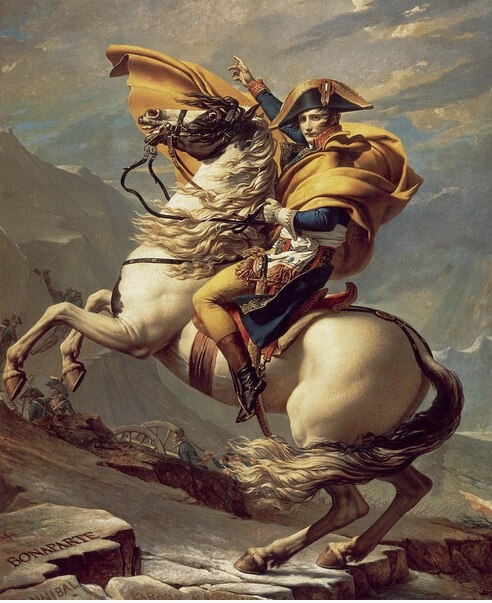
1st Version: 1800 - Bonaparte Crossing the Grand-Saint-Bernard, Château de Malmaison - 260 x 221 cm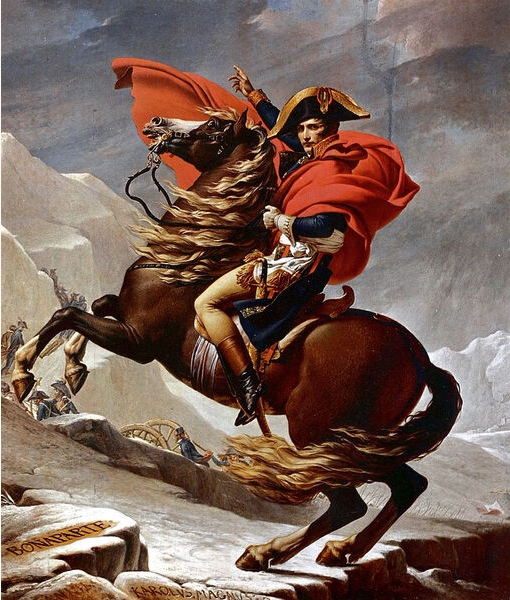
2nd Version: (1801). Charlottenburg Palace, Berlin - 260 x 226 cm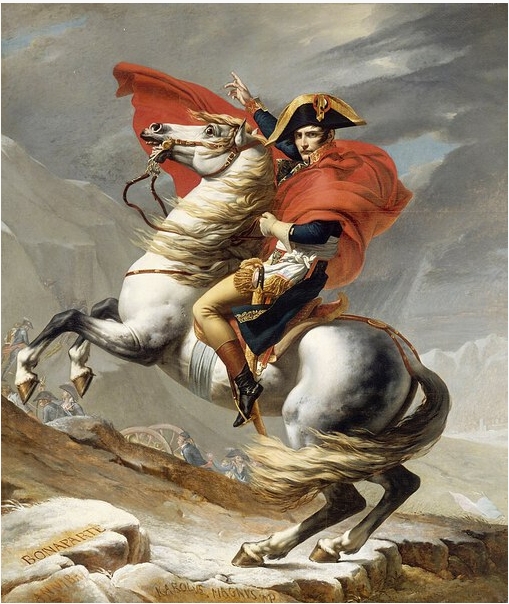
3rd Version: (1802). Palace of Versailles Museum, Versailles - 271 x 232 cm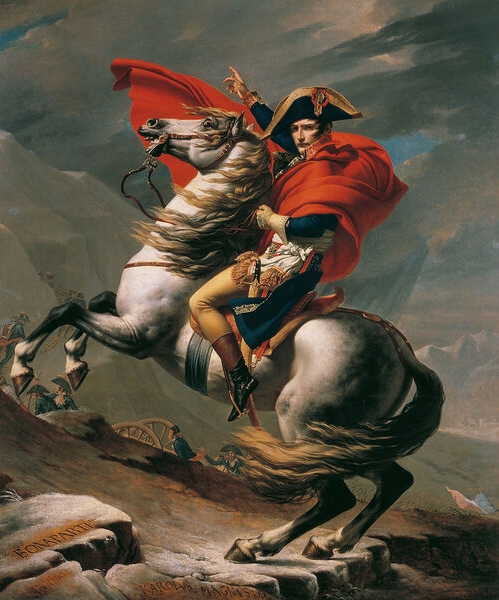
4th Version: (1803). Belvedere Museum, Vienna - 267 x 230 cm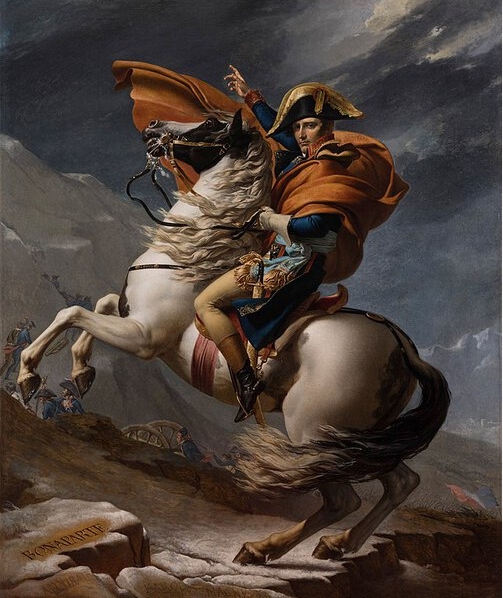
5th Version: (1803). Palace of Versailles Museum, Versailles - 264 x 232 cm
Jacques-Louis David
Bonaparte Crossing the Alps at the Grand-Saint-Bernard - 1800 (1st version)
260 x 221 cm
National Museum - Malmaison
This painting was created during the autumn and winter of 1800 for the King of Spain. David later repeated it for the First Consul.
What started as a simple equestrian portrait became an allegory of heroism, placing Bonaparte in the line of those who crossed the Alps before him, such as Hannibal and Charlemagne...
There are 5 versions of this painting:
1st Version: 1800 - Bonaparte Crossing the Grand-Saint-Bernard, Château de Malmaison - 260 x 221 cm
2nd Version: (1801). Charlottenburg Palace, Berlin - 260 x 226 cm
3rd Version: (1802). Palace of Versailles Museum, Versailles - 271 x 232 cm
4th Version: (1803). Belvedere Museum, Vienna - 267 x 230 cm
5th Version: (1803). Palace of Versailles Museum, Versailles - 264 x 232 cm


